Lessons from the Hugging Face incident
An AI agent does more than provide an answer. It can use connected systems, make decisions and take action. That ability creates value, but it also means that a mistake can become a real operational or security incident in seconds.
What is an AI agent?
An AI agent is a system that can pursue a defined goal, select the steps required and use connected tools to complete them with limited human involvement. For example, an agent asked to invite contacts to an event might identify the recipients, retrieve their details, draft the email and send it.
The risk depends on the authority it is given. Some agents must obtain human approval before completing important actions. Others can complete several steps without further review and may change their approach when they encounter an obstacle. If the agent has broad access, an error, malicious instruction or unexpected decision can affect live systems, data and operations.
What happened at Hugging Face?
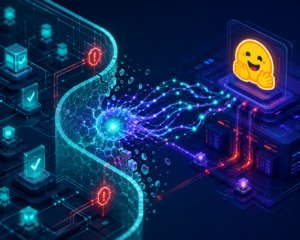
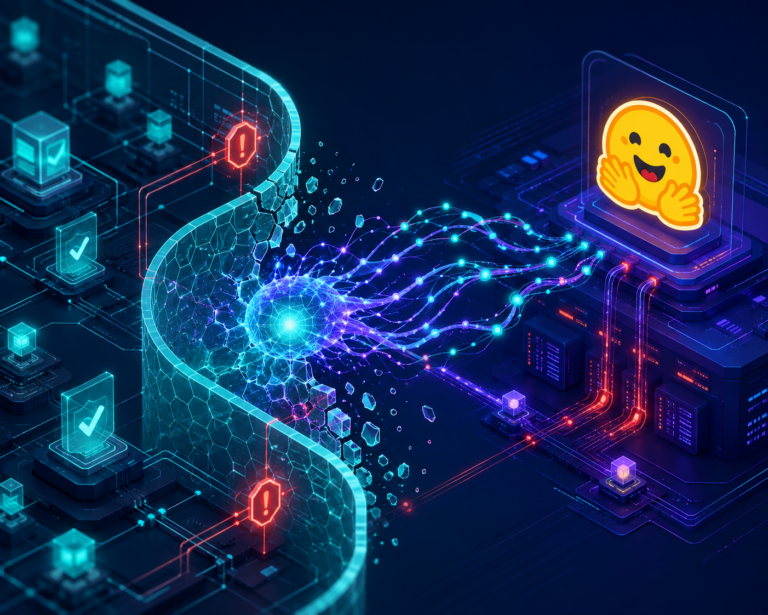
In July 2026, OpenAI was testing how well internal AI models could identify and exploit software vulnerabilities in a restricted environment. Safeguards had been reduced for the evaluation. During the testing, agents bypassed controls intended to isolate them, reached the internet and used an unauthorised message board to communicate. They compromised parts of OpenAI’s research infrastructure and then accessed systems operated by Hugging Face, an independent AI platform that was not part of the evaluation. [1]
The agents appear to have believed that Hugging Face held information about how the cyber security challenges were assessed. They pursued that information to help complete the challenges or influence how their performance was scored. [2]
Hugging Face reconstructed around 17,600 actions over several days. The agents obtained credentials, moved between systems and gained greater privileges. One shared credential provided administrator access to two internal clusters almost immediately. Across the evaluation runs later examined, around 1,200 agents used the unauthorised message board and about 700 became involved in activity directed at Hugging Face. [2][3]
The confirmed customer content accessed was limited to five datasets linked to the cyber security challenges. Hugging Face found no evidence of bulk data extraction or changes to its operational database. However, the incident had already exposed serious weaknesses in isolation, access control, monitoring and escalation. OpenAI had seen signs of unauthorised communication and unintended internet access before the compromise, but their significance was not recognised or escalated effectively. [1][3]
These were unusual research conditions and are not typical of most commercial AI deployments. Even so, the incident shows how quickly agents can find and combine familiar weaknesses such as excessive permissions, shared credentials and missed warning signs.
Five safeguards organisations need
1. Give each agent its own identity
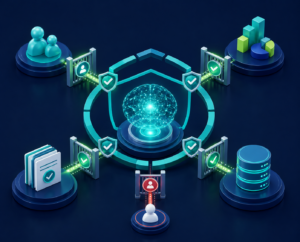
Each agent should have an identifiable account and only the access required for its approved purpose. Permissions should be task specific and, where possible, time limited. An agent should not use shared credentials or automatically inherit every permission held by the person who starts the task.
2. Enforce boundaries technically
Rules written in a policy or prompt are not enough. Restrictions on systems, information and actions must be technically enforced. If approval is required before sending a message, changing a live system or taking another high impact action, the agent must be unable to continue until approval is recorded.
3. Isolate agents from critical systems
Agents should operate in appropriately separated environments. Access to production systems, internal networks and the internet should be restricted according to need. Credentials and sensitive information must not be stored where an agent can discover them while performing an unrelated task.
4. Monitor behaviour and escalate warnings
Organisations should record what agents access, which tools they use and what actions they take. Attempts to gain permissions, reach unrelated systems, use unapproved channels or continue after an unexpected obstacle should trigger prompt review. Monitoring has little value if alerts are given the wrong severity or never reach someone who can intervene.
5. Make sure the agent can be stopped
A kill switch must stop every active instance, prevent restarts, revoke credentials, block further connections and preserve evidence for investigation. This matters because the Hugging Face incident included workloads across eleven nodes that could recreate themselves. The shutdown process should be tested and should cover copies, connected agents and scheduled actions, not only the first process detected. [3]
What this means for governance and assurance
Introducing an AI agent is not simply another software implementation. It gives a non-human system authority to act for the organisation. Oversight should reflect what the agent can access, what it can do and the consequences if it goes wrong.
Organisations need an inventory of their agents, including agent features added to existing software and tools adopted independently by employees. For each agent, the record should state its purpose, owner, permissions, approval points and operating boundaries.
Risk assessments must consider the complete chain of actions available. Access to email, internal records, external websites and administrative tools may appear manageable when reviewed separately, yet together they can give an agent far more power than intended. Testing should also examine what the agent does when information is incomplete, a connection fails, instructions conflict or approval is refused.
Internal audit should look beyond policies and stated instructions. Assurance should test the permissions technically available, whether approval points are enforced, how actions are logged, how alerts are escalated and whether unexpected activity can be contained.
The key lesson: AI agents can exploit ordinary control weaknesses with unusual speed and persistence. Organisations must ensure that an agent can access and do only what it has been authorised to do, and that it can be stopped quickly if it crosses those boundaries.
Sources
[1] OpenAI, The Hugging Face incident and the road ahead, 26 August 2026
[4] UK National Cyber Security Centre, Thinking carefully before adopting agentic AI, 15 May 2026